Islamic geometric ornament for interiors

Begin on a real wall.
End on yours.

Start from a documented panel, tune it live in your browser, and leave with print vectors, seamless repeats and files a maker can cut from.

8-fold star · rendered live · the linework first, then the colour · derived, not generated

Free to exploreCreator from £12.99 / month

Derived, not generated

Watch a plate derive itself.

This is not an animation of a picture - it is the construction performing itself, rendered frame by frame from the engine's own geometry. No motion-graphics tool, no image model.

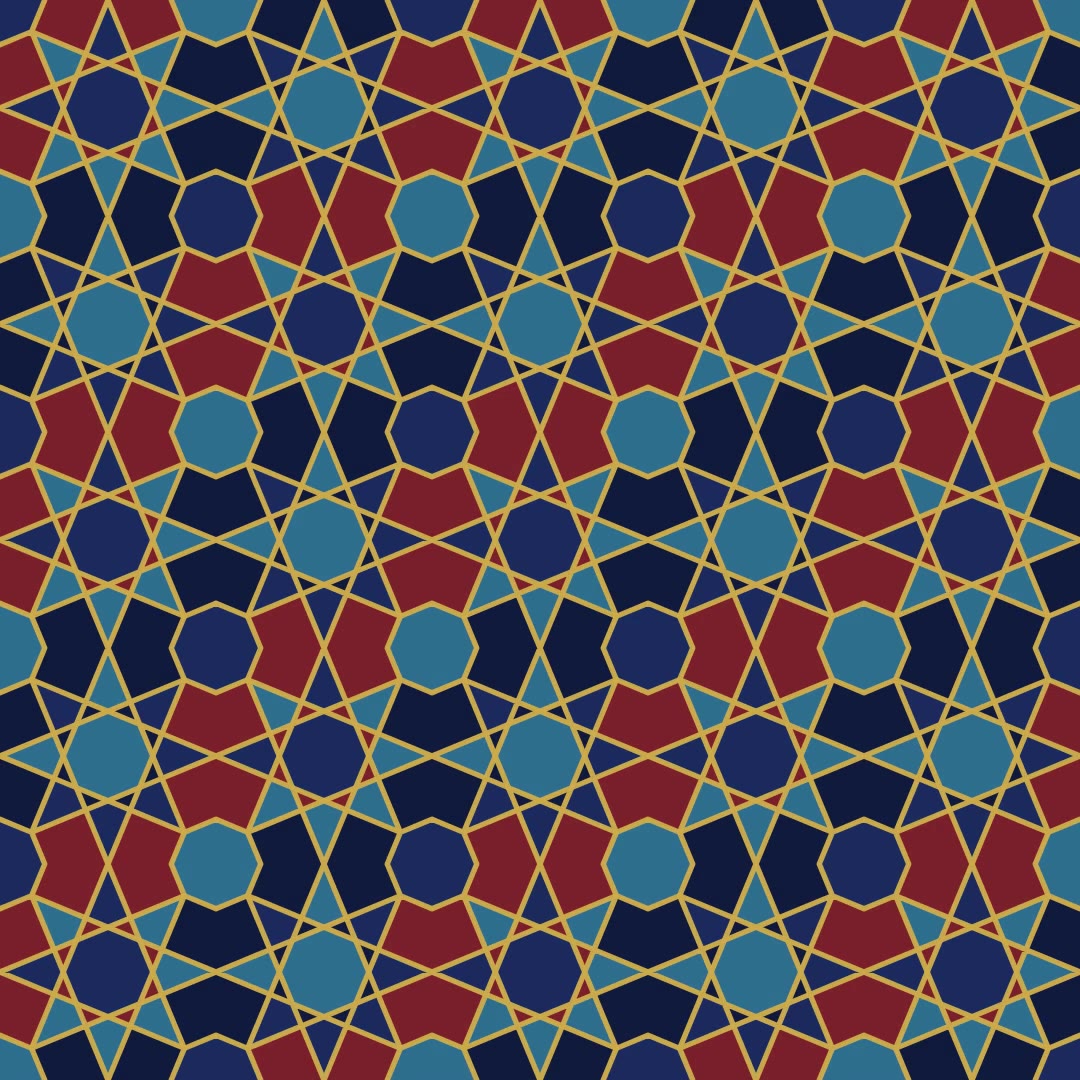
The finished khatam seal construction in lapis and gold

Lines first. Then colour, class by class.

Every stroke you see drawn is a real segment of the engine's geometry, appearing in the order the construction produces it. When the linework is complete, the colour arrives the way a zellige cutter works - one congruence class at a time, one glaze per template, darkest first, until the gold strapwork closes the figure.

The same derivation runs live in the studio, under your hands, at any symmetry.

PLATE II - KHATAM SEAL · POLYCHROME · LAPIS
Derived, not generated

One motif, built the way a master builder built it.

Nothing here is sampled from an image. Every pattern is assembled in order, from a documented tessellation to the strapwork laid over it to the colour. Watch a single eight-fold motif come together in three moves.

iConstruction

The polygons-in-contact skeleton. Every vertex is an exact line intersection, not a placed point.

iiInterlace

The straps are woven into continuous ribbon. Over and under is decided by the geometry, not by hand.

iiiZellige colour

Faces are grouped by congruence and coloured by class, up to six fills, the way a cutter works from one template and one glaze per shape.

Documented provenance

Start from a real wall.

Every session can begin from a documented monument: thirty-two presets in nine regions, from al-Andalus to Mughal India, each with its source on its card. Some are read line by line from a published drawing of a named building; others are the studio's own construction in a monument's tradition, and the card says which. Each panel below opens directly in the studio, already set to that construction and palette; inherit centuries of proven proportion, then evolve the pattern from there. Adapted panels are labelled as adapted, never passed off as the original.

Andalusi
Comares Hall zellige · Granada · 14th c · Nasrid

Cut-tile mosaic assembled from templates, coloured by congruence class.

Maghrebi
Bou Inania madrasa · Fez · 14th c · Marinid

Mature Marinid strapwork in the Fès tetrachord: cobalt, plaster, saffron, copper-green.

Cairene
Ibn Tulun screen · Cairo · 9th c · Tulunid

Among the earliest surviving geometric screens; each grille a different star lattice.

Persian
Sheikh Lotfollah zellige · Isfahan · 17th c · Safavid

Haft-rangi, the Safavid seven-colour tilework, colour fired into the tile itself.

Mughal
Fatehpur Sikri jaali · Agra · 16th c · Mughal

Carved sandstone screens filtering light through the hexagram, the Seal of Solomon.

The nine regions of the gallery: Andalusi · Maghrebi · Cairene · Levantine · Anatolian · Iraqi · Seljuk and Caucasus · Persian · Mughal Open all thirty-two presets

Chromatic control

Colour is a control, not an afterthought.

Colour by congruence class, one fill per shape from a ladder of six, as a plate's colour law assigns them. Recolour a single face or a whole class by hand with the zellige picker, or pull the palette toward a target across the surface. Everything carries through to every export, so the sample you show a client is the file the maker receives.

Colour by classEvery shape class takes its own fill, A to F. A field read from a plate follows its drawing's roles; any other field goes largest class first.
Spot colouringTap any tile to recolour it, or paint its whole class in one tap. The change follows through to SVG and PNG.
MetamorphosisDrift the polychrome palette horizontally, vertically or radially for a graduated field.
Never adjacentIn the classical two-colouring, a bipartite rule guarantees no two neighbouring faces share a colour.
Before you commit

See it fired, on the wall, and against the last idea.

Judge a pattern as glazed tile, at true size, in the room, before anything is cut. The Glazed tile view shows the drawing as fired ceramic, computed in the browser from the pattern's own geometry by a material model, so every tile in the picture is a piece the drawing cuts. The room preview composites it into authored scenes, perspective-correct, with the room's own light recovered over the tiles. The same panel leaves as an AR file at true scale, pinned to a real wall through the phone's camera. The geometry you are looking at is the geometry that leaves: the same repeat exports as print vectors and a workshop cut schedule at the same dimensions.

Compare with snapshot Set a saved version beside the current one and decide which to send.
Snapshot A8-fold · lapis / gold
Current12-fold · water / crimson
From the studio to the workshop

Files a maker can cut from.

This is where the exact geometry earns its keep. Before a single file leaves the studio, Zakhraf measures the pattern in millimetres against your tool and counts every piece. Two downstream paths ship from the same click: line-work for a CAD shop, one layer per stone, and a dimensioned template sheet for a workshop that cuts by hand. A dado, the field between two friezes with their listels, ships as one job, counted and cut together. The screen and the cut file share one geometry, so what you see is what ships.

Fabrication check

Every export is measured against your machine before it saves.

Narrowest face18.1 mm
Strap width4.2 mm
Laser · 2 mm minpasses
CNC router · 4 mm minpasses
Zellige tile · 6 mm mincheck at this size

For the hand workshop

A maalem does not need a CAD seat. The cut schedule counts every piece by template class, with its inscribed circle in millimetres and the pieces per square metre, and the tile module prints at true size, the sheet a hand-cutter works from. The concept sheet carries palette, dimensions and provenance to the client.

Pattern repeat1200 × 1200 mm
Tile module150 × 150 mm
Base tiles required180 (order 198)
Pieces per square metrecounted from one repeat
Congruence classeson the CSV
Historical provenanceon the PDF

For screen

  • PNGScreen-size raster, flat or fired as glazed tile, with an optional provenance footer
  • CSS data URIOne exact period, tiles seamlessly

For print

  • SVGTrue vectors to 2400 px: field, dado or arched panel
  • Repeat tileSeam-verified for fabric and wallpaper
  • Concept sheetA4 PDF with palette, dimensions and provenance; carries the fired tile

For fabrication

  • DXFLine-work for CAD shops: AutoCAD, Rhino, VCarve. One layer per cut-schedule row, in its stone's colour
  • Tile moduleThe hand-cutter's template, printed at true size in millimetres
  • Cut scheduleEvery piece counted by template class, as CSV with a labelled cutting sheet
For the record: constructed, not drawn.
Read the mathematics: why every line is derived, not generated →
√2, √3, φEvery vertex is derived from exact irrationals. No decimal literal in any computation.
Hankin 1925The polygons-in-contact method the tradition is built on, implemented exactly.
Seam-verifiedRepeat tiles are pixel-identical under one-period translation, or the export is refused.
Six to twelve-foldStars of 6, 8, 10 and 12 points. A repeating pattern itself can only turn by 2, 3, 4 or 6, the crystallographic restriction; the higher orders live in its stars.
The Foundation Series

Six constructions, six material worlds.

The studio's canon: six constructions that carry most of the tradition between them, each rendered in one of the documented material palettes - brass, lapis, marble, parchment, jade and the Fès tetrachord. Every plate is exact engine output. Open any of them and the construction is live under your hands.

Questions

Asked, answered.

Is Zakhraf Studio AI image generation?

No. Nothing here is sampled or generated from images. Every pattern is constructed live by a geometry engine from documented historical tessellations - the same compass-and-straightedge logic the original craftsmen used - so every line has a stated construction behind it. Derived, not generated.

Do the patterns tile seamlessly?

Yes. Every construction is built on a repeating lattice, so exports include a seamless repeat tile alongside the full panel. The room preview is calibrated to physical scale: choose a 300 mm repeat and you see a 300 mm repeat on the wall.

What can I export?

The Free tier renders everything in the browser and exports a watermarked PNG, flat or as glazed tile. Creator unlocks watermark-free PNG, print-ready SVG to 2400 px, the seamless repeat tile, CSS, and the fabrication files: DXF for CNC and laser, the cut schedule at true dimensions, the tile module and the concept sheet PDF, with a dado composition cut as one job. It also exports an AR panel at true scale, the fired tile as a USDZ that pins to a wall through an iPhone or iPad's camera, and as a GLB for other viewers.

Can I see a pattern as real tile before anything is made?

Yes. The Glazed tile view, free in the studio, shows any Islamic pattern fired as glazed ceramic: tile boundaries, joints sized to the pieces, a rounded glaze edge, the glaze's thickness and reflection, grout. It is computed in the browser from the pattern's own geometry by a material model, not an image model, so every tile in the picture is a piece the drawing cuts. The room mockup, the PNG export and the concept sheet carry the fired tile.

Does the studio work in other languages, or offline?

The studio runs in English, French, Arabic (right to left), Spanish and Chinese, in a light or dark theme, and installs as an app that keeps working without a connection, so it opens on a tablet at a client's site. A share link carries the whole pattern, its palette and its millimetre scale, so whoever opens it sees the same piece at the same size.

Can I use the patterns commercially?

Yes - patterns exported while you hold an active Creator subscription (£12.99 a month) may be used commercially. Free-tier exploration is for personal use.

Is Zakhraf Studio a design agency or a freelance designer?

No. Zakhraf Studio is software - a self-serve pattern studio that runs in your web browser at zakhraf.studio. It is not a design agency, a surface pattern design service, or an individual designer's portfolio, and it is not affiliated with other designers or businesses that use the word zakhraf (an ordinary Arabic word meaning ornament) in their names. If you are looking for the pattern software, zakhraf.studio is the address.

Are the patterns historically accurate?

Every historical preset carries a card that says what it rests on. Some are read line by line from a drawing or a published plate of a named building: the Mamluk twelve-and-eight panel, the Malatya, Kayseri and Erzurum fields, the Barquq floor, the Mustansiriya brickwork. Others are the studio's own construction in the tradition of a monument, the Ibn Tulun screen, the Sheikh Lotfollah tilework and the Fatehpur Sikri jaali among them, and their cards say so. Where a source does not say where on a building a pattern sits, the card says that too, and an adapted pattern is labelled as adapted, never passed off as the original.
Pricing

Free to explore. Creator to ship.

Zakhraf runs free forever for exploration and personal use. Creator unlocks the exports and fabrication documents needed to put a pattern onto a product, under a commercial licence.

Explore
Free
£0always

No account required.

  • All Islamic symmetries: 6, 8, 10 and 12-fold
  • Every construction: nine girih modes, twenty-two historical fields, four cut-tile mosaics
  • Tiled, medallion, dado and arched-panel layouts
  • Thirty-two historical presets in nine regions, each with its source on its card
  • Polychrome zellige coloured by class, spot colour, material bands and ribbon strapwork
  • Glazed tile view and room mockups at true scale
  • Two projects with six snapshots each, side-by-side compare, share links
  • PNG export with a small Zakhraf watermark; five languages; works offline
Open the studio
Ship
Creator
£12.99per month

Seven-day free trial. Cancel any time.

  • Everything in Free, plus:
  • Generative, Grid and Sacred engines, and the brass, zellige and nacre material palettes
  • Level-2 polychrome, compound rosettes two and three levels deep, colour metamorphosis
  • Watermark-free PNG and SVG to 2400 px, CSS, seam-verified repeat tile, concept sheet PDF
  • DXF for CNC and laser, cut schedule, tile module, fabrication check with coverage calculator
  • AR panel at true scale: a USDZ that pins to a wall in AR Quick Look, and a GLB
  • Commercial licence, unlimited projects, thirty snapshots per project
Open the studio and upgrade inside
One workflow

From the fourteenth century to your CNC.

The origin · 14th c
The historical discipline

A documented wall, cut by hand from single templates.

The translation · today
Exact digital tuning

The same construction, derived analytically and tuned live.

The execution · 21st c
Toolpaths and schedules

Fabrication files a maker reads without redrawing.